
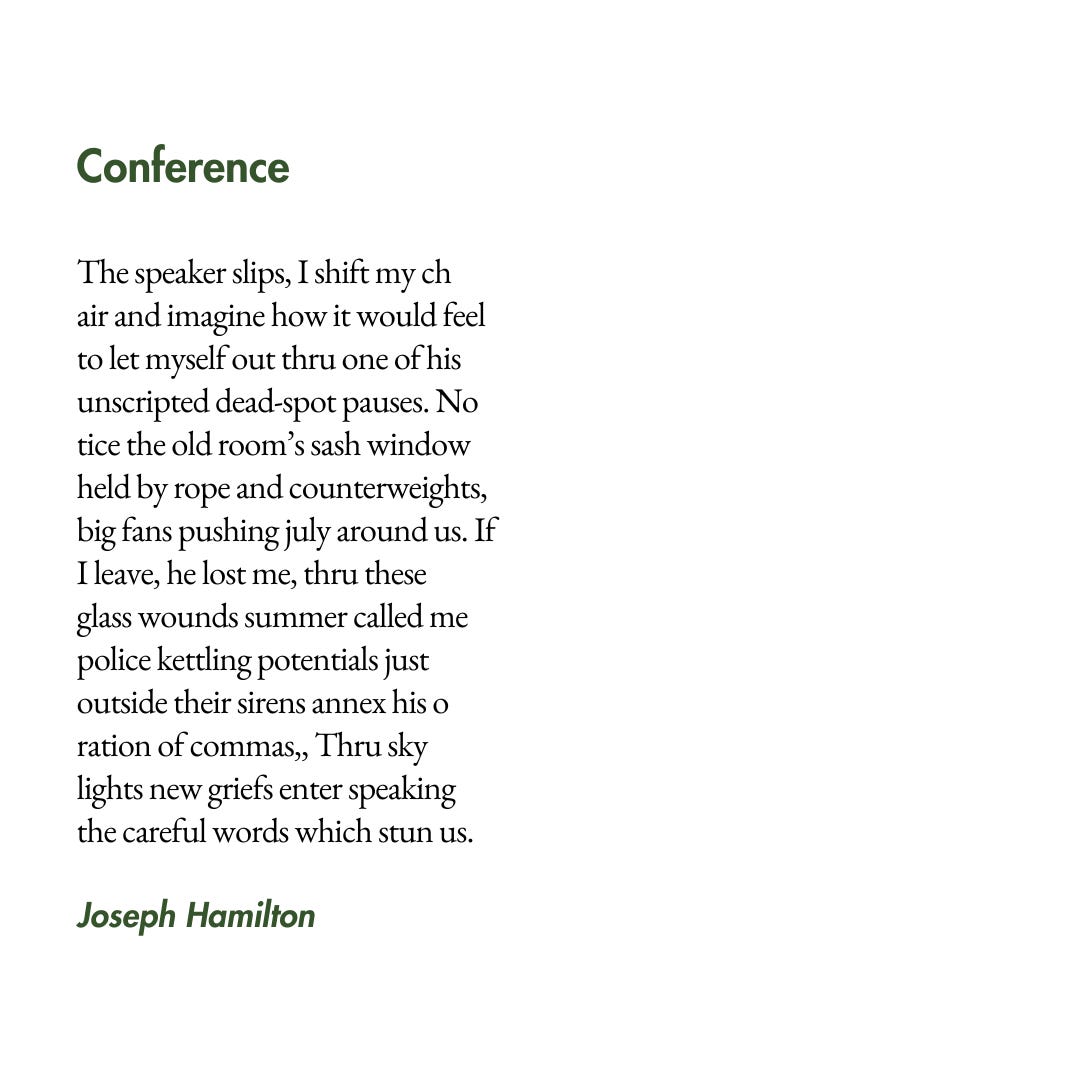
Conference
a poem by Joseph Hamilton + interview


Bold, gutsy poetry straight to your inbox every Friday morning.
We’re open for submissions right now!
Joseph Hamilton is a poet and editor from London, UK. He has most recently been published, or has work forthcoming, in Stones of Madness, &Change, GARLAND and Running Dog. In 2023, he co-founded the zine boundby, where he now acts as Editor-In-Chief. Of late, he is writing dizaines in response to the Paris Commune of 1871, but don’t ask him about it yet.
Interview with Joseph…writing is a way of thinking?
Maria: Joseph! Wow. What a poem. To me, it feels like that drifting, almost dissociative feeling of being trapped in a room while the world outside feels urgent. When you wrote it, how (or) were you thinking about the movement of attention, what it latches onto, what it escapes toward?
Joseph: Yes, definitely. And, as I realised a little while into writing, the poem can’t really take sides in a situation like this, when attention is split or interrupted. But it is definitely a negotiation, for sure. The poem is always vying, even if unable to commit.
Maria: Your enjambment needs to be studied. What was your thought process behind the fragmentation?
Joseph: I was thinking about the limits of the poem, and about the poem as an agitator in this drama between inattention and focus. In this light, the breaks in words and over lines are responses to a physical limit, like the limiting factors of the room and the speaker and the moment of protest in the poem. Any bifurcation in the words’ meaning as a result of these breaks are coincidences, little reactions to the material conditions at play.
Maria: Poets often talk about poetry being a practice. A way of living. How does that resonate in your daily life? Why do you write?
Joseph: Writing is a way of thinking, which is, fortunately and unfortunately, a big part of living. For me poetry doesn’t come very naturally, and is difficult. But the only alternative would be not thinking, and forgetting. Writing poems feels like the way into a lot of things, but almost never the way out. Never quite the completed thought.
Maria: Do you see your work as part of a tradition, or as pushing against one? Or both?
Joseph: Politically, yes. My work is in deference to so many radical poets and a diverse yet concerted tradition of insurgent poetry and poetics. Julianna Spahr, Rob Halpern, Sam Solomon, Nat Raha. Too many to mention.
This poem in particular is also an accidental Sonnet, which comes with its own poetic and historical baggage, as well as rules. I am interested in how poems deal with these questions of law, restriction, and, extrapolating further, the state, the police, militarism and imperialism. I very much ascribe to Spahr’s characterisation of poems as being akin to the riot dogs of Athens; the poem’s contribution towards resisting any of these institutions of power is hard to measure, undeniably limited, and endlessly surprising.
Maria: Lastly, we often speak of what poetry is. I’m curious what you think poetry isn’t.
Joseph: Poetry isn’t enough. It’s not the work itself, but rather how we show our workings.
Maria: Thank you so much for giving us the honour of publishing your work. Tell us where we can find you, say hi, and read more of your work!
Joseph: Thank you for Gather, and for your sensitive reading of my poem. I am most active in an editorial capacity through boundby poetry magazine, where I am always down to talk poetry and happy to read (almost) anything that comes my way. My own poems are here and there, online and in print, even if a little hard to come by.
We’re open for submissions right now.
Submit on Submittable.
Lots of love,
EIC and Founder of Gather
🪑Gather is a writing table, lit mag, and podcast. In short: a home for poets.
You can join the waitlist for our writing table, submit your work to our lit mag, or watch our podcast episodes here.🪑
 | A guest post by
|
Wow, indeed. Awesome poem!!