
fruity ennui
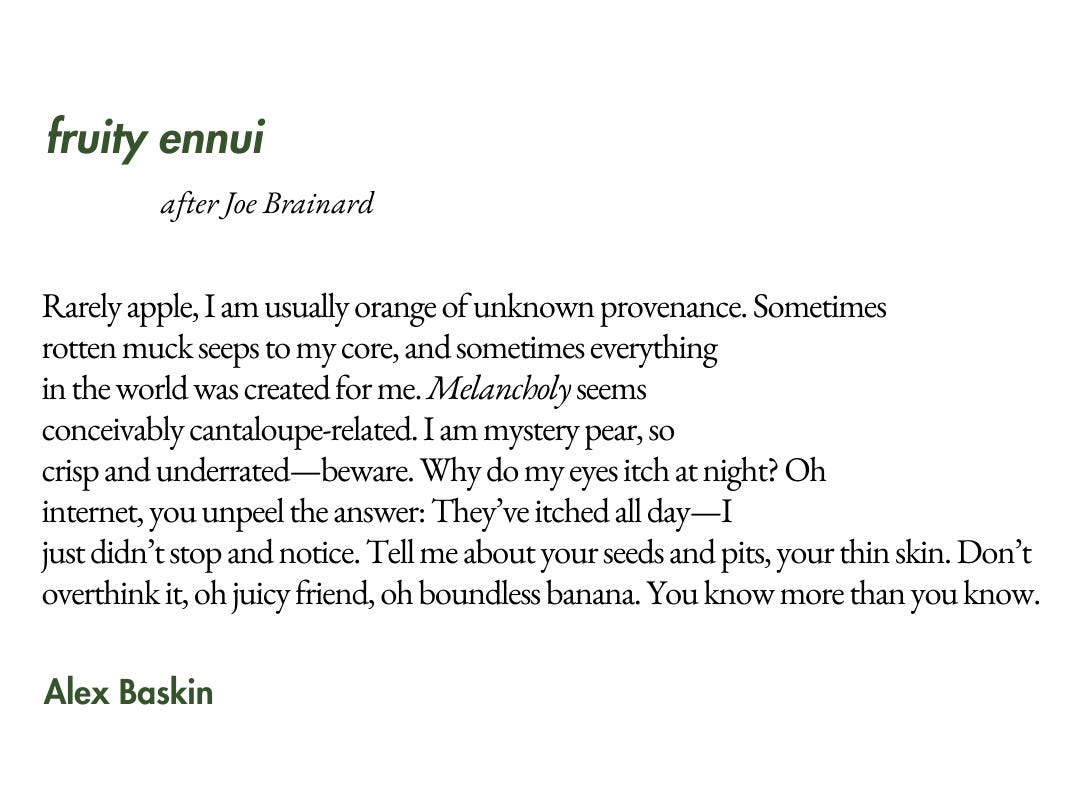
a golden shovel poem by Alex Baskin + interview


Bold, gutsy poetry straight to your inbox every Friday morning.
We’re open for submissions right now!
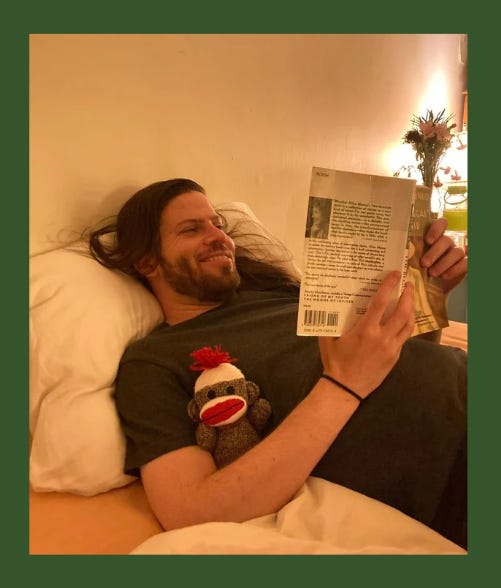
Alex Baskin is the author of the chapbook I wake up tangled in pillows and sheets (Fork Apple Press, 2025). His poems have been shared in Gulf Coast, poetry.onl, Redivider, and elsewhere. He works as an interfaith hospital chaplain. Originally from New Jersey, he lives in Massachusetts.
Interview with Alex…what poetry is and isn’t.
Maria: Alex! I love golden shovels, and yours was not an exception. How did you navigate the tension between your own voice and the lines you were “given”? Did it feel limiting, freeing, or both?
Alex: Maria! Both! I chose Brainard’s extremely brief poem because it is one of my all-time favorites, and, more to the point, because I deeply relate to the sentiment that I perceive in it: almost too fatigued by life to even pinpoint one’s own feelings. So basically I didn’t think that there was a ton of distance between his voice and mine (though obviously there’s massive distance between his skill and mine, but that’s a different story). So yeah, we can talk more about form; of course there was literally a kind of delimitation since I had to use his words and couldn’t even conjugate them or anything, but there was plenty of freedom within that. At least I didn’t have to pay attention to something like meter. I’m terrible at that.
Maria: The poem mixes melancholy, curiosity, and humour. When you wrote it, were you thinking more about playing with form, exploring emotion, or both at once?
Alex: Both again! Of course, the form creates a constraint that is generative and challenging (really, generative because it is challenging.) But basically I think of forms like this or even a sestina (forms where I’m aiming for a line-ending word) as a “set it and forget it” kind of thing. I tried to let the poem breathe as much as possible, all the while knowing that I had to reach a specific word by the end of the line. And sure, that requirement does create an atmosphere. Without having to force it, the poem ends up dwelling in or even expanding on the emotional landscape that I sensed in Brainard’s poem. I enjoyed the process and I’m glad you liked the end result.
Maria: What is some solid craft advice you return to?
Alex: Look every word dead in the eye and ask: do you need to be here? If you’re tripping over it even slightly, guaranteed the reader will.
Maria: Many poets experience physical feelings when they read a good poem. Emily Dickinson famously said she feels like the top of her head is coming off. What physical sensations happen to you when you read or write a good poem?
Alex: I love that Dickinson adage and I love this question. I guess for me it’s just feeling more present in my body as a whole, if that makes sense. I’m a meditator, so for years I’ve been developing (or trying to develop) the capacity to connect to a felt-sense awareness in the body. Basically, it’s a life project to get out of my own head, so to speak. I do think good writing can dimensionalize us; it can literally flesh out our embodied, human experience.
Maria: Lastly, we often speak of what poetry is. I’m curious what you think poetry isn’t.
Alex: Hmm, I’m having trouble with this one. I know what poems I don’t like: anything that reads to me as didactic, saccharine, trying too hard to sound poetic, or opaque for opaque’s sake. But I’m not too interested in telling anyone else what poetry is or isn’t.
Maria: Thank you so much for giving us the honour of publishing your work. Tell us where we can find you, say hi, and read more of your work!
Alex: You can check out my fairly bare-bones website alex-baskin.com or my sporadically-active Instagram @alex.baskin . Thanks again for these thoughtful questions, for appreciating this poem, and for your kindness.
We’re open for submissions right now.
Submit on Submittable.
Lots of love,
EIC and Founder of Gather
🪑Gather is a writing table, lit mag, and podcast. In short: a home for poets.
You can join the waitlist for our writing table, submit your work to our lit mag, or watch our podcast episodes here.🪑
 | A guest post by
|