


Bold, gutsy poetry straight to your inbox every Friday morning.
We’re open for submissions right now!
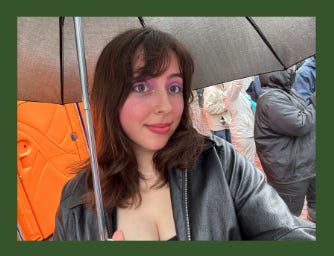
Amiel Katz (she/her) is a Salvadoran poet from Houston, Texas. She roots her writing in historical research and (re)imagines just futures for migrants and marginalized identities. Her work is featured in Nowhere Girl Collective and is forthcoming in Horizon Review and Bat City Review. You can find her on Substack @philomath4.
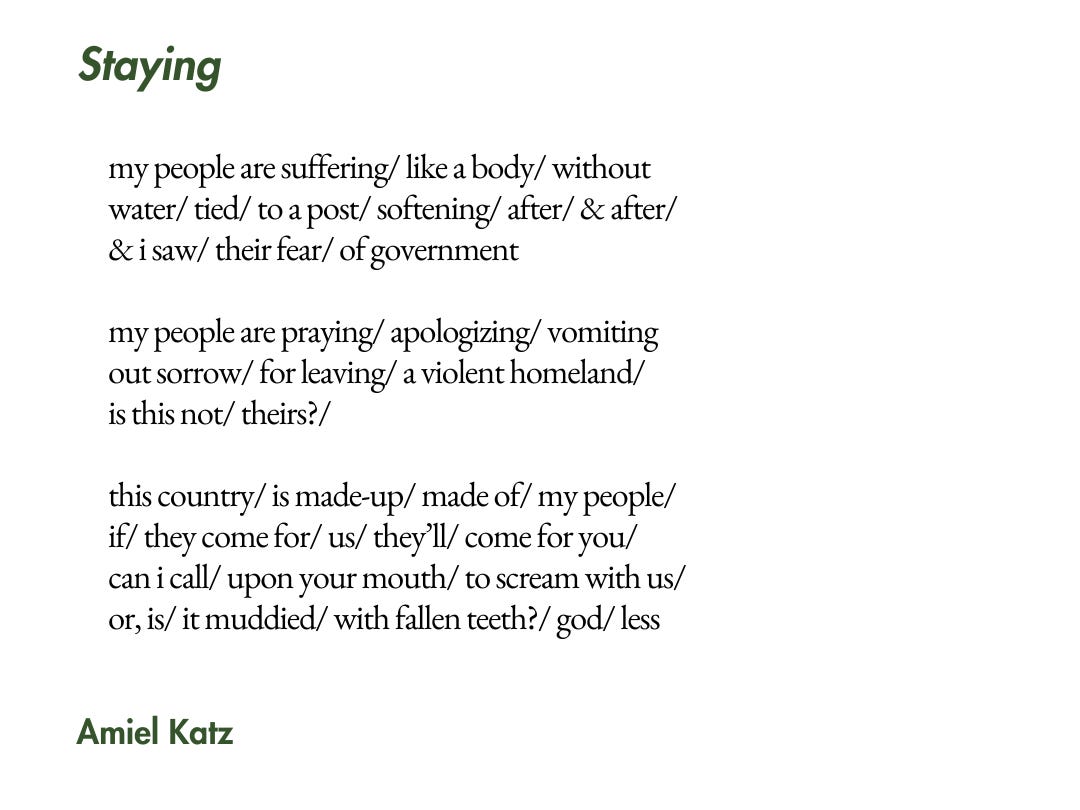
Maria: Amiel! It’s such an honor to publish your work. The poem begins with “my people are suffering / like a body / without water / tied / to a post.” How did you arrive at this physical metaphor, and what did it allow you to say that a more direct political statement wouldn’t?
Amiel: Hi Maria! Thank you for having me. I arrived at this metaphor through thinking of the emotions my immigrant community is experiencing. I thought of the frustration of lawlessness, which reminded me of Mexican lynching in the American South throughout the 1800-1900s, and pushed me to illustrate the body tied. Saying that my people are without water is like saying they are thirsty for justice, yet every day someone takes more water away. Having this metaphor allowed me to call in these historical references and bring them to the present day.
Maria: How does the title Staying complicate the poem’s concerns with leaving, exile, and survival?
Amiel: I chose to title this poem “Staying” when I remembered how Mexican families across the southern U.S. border state, “We didn’t cross the border. The border crossed us.” With the U.S. conquering half of Mexico’s territory in 1848, many Mexican and Indigenous families found themselves on one side of the border. They didn’t move, but the U.S. government claimed their invasiveness. “Staying” challenges who originated in the land and who will keep living there.
Maria: When you turn to poetry, what are you trying to survive, understand, or say?
Amiel: I am a trained historian, yet in academic writing, I don’t really have the space to use language to make sense of my emotions. Poetry helps me understand and contemplate what I can do with the information I have.
Maria: I always ask this question because I find the answers so interesting. Many poets experience physical feelings when they read a good poem. Emily Dickinson famously said she feels like the top of her head is coming off. What physical sensations happen to you when you read or write a good poem?
Amiel: When I read a good poem, I become so excited. I annotate the page ravenously. I reread and reread until my eyes become tired. I absolutely send pictures of the poem to my loved ones. When I read a good poem, I feel grateful that someone could say something that others might be scared to.
Maria: Lastly, we often speak of what poetry is. I’m curious what you think poetry isn’t.
Amiel: Poetry isn’t a standalone solution. Poetry helps us understand what we are experiencing, but it’s where and how we gather after reading or writing poetry that pushes for change.
Maria: Thank you so much for giving us the honour of publishing your work. Tell us where we can find you, say hi, and read more of your work!
Amiel: Thank you so much, Maria! You can find me on substack Philomath
We’re open for submissions right now.
Submit on Submittable.
Lots of love,
EIC and Founder of Gather
🪑Gather is a writing table, lit mag, and podcast. In short: a home for poets.
You can join the waitlist for our writing table, submit your work to our lit mag, or watch our podcast episodes here.🪑
